

As parents, we often wonder whether our child is truly understanding what is taught in school or simply memorising answers for exams. This is where the way a curriculum is designed becomes important. The CBSE Curriculum: Complete Guide for Parents (2026-27 Edition) helps parents understand how the CBSE education system is moving towards meaningful, practical and skill-focused learning.
For families considering a CBSE school, it is useful to look beyond textbooks and marks. The CBSE curriculum 2026-27 places importance on understanding concepts, applying knowledge, developing skills and encouraging students to become confident learners.
What Makes the CBSE Curriculum Different?
A major strength of the CBSE curriculum is its focus on understanding rather than learning everything by heart. Memorisation still has its place, but students are increasingly encouraged to understand why something works and how they can use that knowledge.CBSE Curriculum: Complete Guide for Parents (2026-27 Edition)
For example, instead of simply memorising a science definition, a student may be encouraged to observe an everyday situation and connect it with the concept taught in class. Similarly, mathematics can involve solving practical problems rather than only practising the same type of question repeatedly.
This approach can make classroom learning more meaningful. When children understand the reasoning behind a concept, they are more likely to remember it and use it in a new situation.
The CBSE syllabus also provides a structured academic framework while giving schools opportunities to use activities, projects and classroom experiences to make learning more engaging.CBSE Curriculum: Complete Guide for Parents (2026-27 Edition)
How Does CBSE Encourage Better Learning?
1. Stronger Conceptual Understanding
Children learn better when they understand the basics clearly. The CBSE education system encourages teachers to explain concepts through examples, discussions, activities and questions.
Suppose a child is learning fractions. Instead of only solving textbook questions, the teacher might use examples involving sharing a pizza, dividing a chocolate bar or measuring ingredients. Such examples connect mathematics with everyday life.
This type of conceptual learning helps students build a stronger foundation for future classes.
2. Experiential and Activity-Based Learning
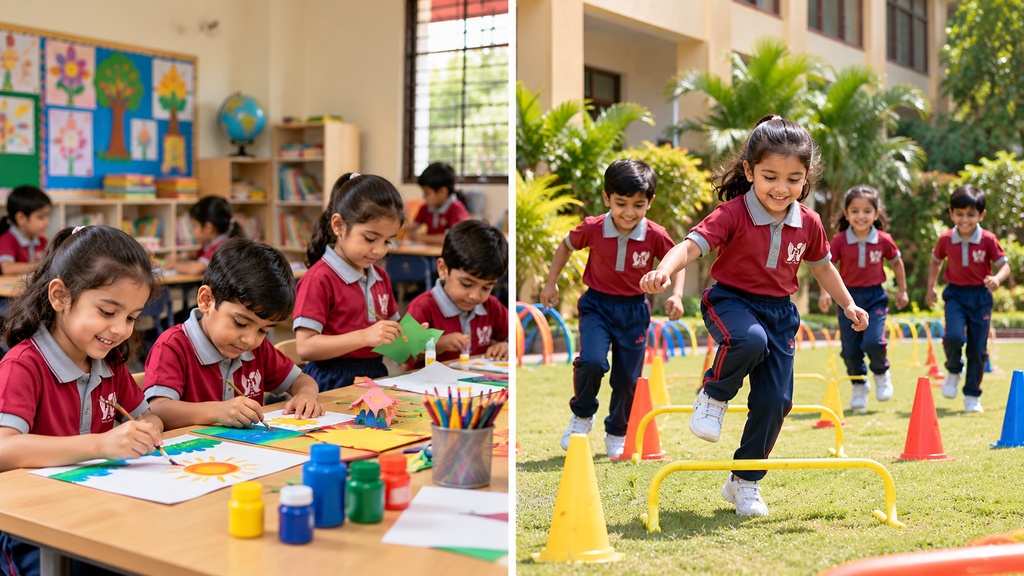
Children naturally learn by doing. The CBSE approach encourages experiential learning, where students get opportunities to explore ideas instead of only listening to explanations.
Science experiments, group projects, classroom activities, art-integrated tasks and educational visits can give students a chance to experience what they are learning.
For parents, this is an important part of the CBSE Curriculum: Complete Guide for Parents (2026-27 Edition) because learning does not have to happen only through notebooks and homework. A well-designed classroom experience can make a difficult concept easier to understand.
3. Critical Thinking and Problem-Solving
A child may know the correct answer but still struggle when a question is presented differently. This is why critical thinking matters.
CBSE learning increasingly encourages students to analyse information, ask questions, compare ideas and find solutions. Instead of always asking, “What is the answer?”, students can also be encouraged to think, “Why is this the answer?”
For example, a teacher may present a real-life problem and ask students to discuss different possible solutions. This develops reasoning and problem-solving abilities that can be useful both inside and outside the classroom.CBSE Curriculum: Complete Guide for Parents (2026-27 Edition)
4. Competency-Based Learning
Competency-based learning focuses on what students can actually do with the knowledge they have gained.
A child may learn a mathematical formula, for instance, but competency-based learning encourages the child to apply that formula to solve a practical problem.
This shift can help students move from simply remembering information to demonstrating understanding, application and skills.
5. Interdisciplinary Learning
Real life does not divide knowledge into separate textbook chapters. A single project may involve mathematics, science, language, creativity and technology.
Interdisciplinary learning allows students to make connections between different subjects. A project on water conservation, for example, could involve science concepts, mathematical calculations, writing skills and creative presentation.
Such activities can help children see how different areas of knowledge work together.
6. Skill Development
The CBSE curriculum also gives importance to skills that students need beyond examinations. Communication, collaboration, creativity, digital awareness and problem-solving are increasingly relevant to a child’s overall education.
Students may develop these abilities through presentations, group work, projects, practical activities and classroom discussions.
The Role of Assessments in CBSE Learning
For many parents, assessment immediately brings exams and marks to mind. However, assessment can be much more useful when it helps teachers understand what a child knows, what the child is struggling with and where additional support is needed.
The CBSE assessment pattern increasingly includes questions that test understanding and application rather than relying entirely on direct recall.
For example, instead of asking students to reproduce a definition, an application-based question may ask them to use the concept in a practical situation.
Regular classroom assessments, projects, activities and examinations can therefore provide different opportunities for students to demonstrate their learning.
Parents should also remember that one test does not define a child’s ability. The more useful question is whether the child is improving over time and developing confidence in learning.
How Does the CBSE Curriculum Support Holistic Development?
Education is not only about scoring well in mathematics, science or languages. Children also need opportunities to communicate, create, cooperate and develop healthy habits.
The CBSE curriculum supports holistic development by giving importance to academic learning along with life skills, creativity, physical activities and co-curricular experiences.
Sports can teach teamwork and discipline. Art and cultural activities can encourage creativity and self-expression. Group activities can help children communicate and cooperate with others.
Emotional development is also important. A supportive school environment can help children become more comfortable asking questions, making mistakes and trying again.
The goal is not to remove academic expectations but to create a learning environment where children can grow in more than one area.
What Should Parents Know About the CBSE Curriculum: Complete Guide for Parents (2026-27 Edition)?
Parents do not need to become education experts to support their child’s CBSE education. A few simple habits can make a meaningful difference.
First, focus on understanding rather than asking only about marks. Instead of saying, “How many marks did you get?”, try asking, “What did you learn today?” or “Can you explain this to me?”
Second, encourage children to connect school lessons with everyday situations. Cooking can introduce measurements, shopping can involve calculations, and reading newspapers or age-appropriate articles can encourage language and general awareness.
Third, avoid putting unnecessary pressure on children to be perfect. Mistakes are a natural part of learning. If a child finds a topic difficult, identify the specific area that needs attention instead of treating the entire subject as a problem.
Finally, maintain regular communication with teachers. Parents and teachers can work together to understand a child’s strengths, learning gaps and progress.
Final Thoughts
The CBSE Curriculum: Complete Guide for Parents (2026-27 Edition) is not simply about understanding a syllabus. It is about understanding how children can learn through concepts, experiences, skills, application and continuous improvement.
A good CBSE learning environment can encourage students to ask questions, think independently, solve problems and connect classroom knowledge with everyday life. At the same time, parents play an important role by providing encouragement and a positive learning environment at home.
For parents choosing a school, the curriculum is only one part of the decision. The way a school implements the CBSE syllabus, supports individual learners and balances academics with holistic development matters just as much.
Ultimately, better learning happens when children are not afraid to ask questions and are given opportunities to understand, practise and apply what they learn. That is the real value parents should look for when evaluating the CBSE Curriculum: Complete Guide for Parents (2026-27 Edition).

Pingback: Best School In Sigra Varanasi | Parent Guide 2026-27